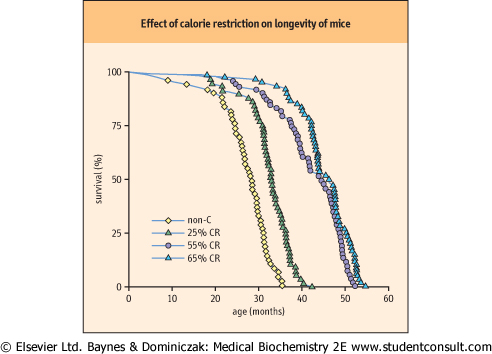
| Calorie restriction (CR) is the only intervention that consistently extends maximum lifespan in a variety of species, including mammals, fish, flies, worms, and yeast. Reduction in total caloric intake appears to be the essential feature of this intervention, i.e. the beneficial, life-extending effects are observed whenever CR is applied and regardless of dietary composition, although early and prolonged intervention has more impressive effects. As shown in Figure 42.8, CR leads to a significant increase in the maximum lifespan of laboratory rats, equivalent to extending human lifespan to about 180 years. The extension in maximum lifespan is accompanied by an overall improvement in the health of the animal. Control experiments have established that the effects of CR are not attributable to toxins in the animal chow.
|
| Based on analysis of gene expression, CR appears to limit chemical damage to DNA to and to promote the turnover of tissue proteins. Calorie-restricted rats had fewer muscle fibers lacking in cytochrome oxidase and decreased levels of deletions in muscle mitochondrial DNA. CR mice also have lower levels of inducible genes for hepatic detoxification, DNA repair and response to oxidative stress (heat shock proteins), suggesting a lower rate of chemical damage to proteins and DNA during CR. In CR experiments, it has been difficult to differentiate between the effects of dietary restriction on energy consumption versus the reduction in body weight that accompanies dietary restriction. However, recent experiments in a mouse model with knock-out of the adipose tissue insulin receptor gene, suggest that adiposity may be more important than caloric consumption per se. Compared to normal littermates, the knock-out mice were leaner, with a 50% decrease in fat mass, but consumed identical amounts of food per day (actually more than the control animals when normalized to their body weight). The 20% increase in lifespan of the knock-out mice, compared to controls, suggests that energy utilization and storage is more important than total caloric intake in determining maximum lifespan potential.
|
| page 606 |  | | page 607 |
| Figure 42.8 Calorie restriction extends longevity of mice. The Non-CR group received food ad libitum. Other groups were restricted by 25, 55 and 65% of the ad lib diet, starting at 1 month of age: (♦) ad libitum fed mice; (▴) 25% CR; (•) 55% CR; (▴) 65% CR (adapted from Weindruch R, et al.: Retardation of aging in mice by dietary restriction. J Nutr 1986;116:651-654). |
|